Choosing between wood and vinyl fencing in Southern California means thinking beyond just the price tag at installation. The real question is how much each material will cost you over a full decade when you add up maintenance, repairs, and potential replacement. Over 10 years in Southern California, vinyl fencing typically costs less than wood when you include staining, sealing, board replacement, and labor, even though wood starts at a lower upfront price.
Southern California’s climate plays a major role in how each material performs. Intense sun exposure, dry heat, occasional heavy rain, and pest activity all impact how often you need to maintain or repair your fence. Wood requires regular staining or sealing every few years to prevent cracking, fading, and rot, while vinyl resists moisture and UV damage with minimal upkeep.
This breakdown looks at the true cost of ownership for both materials across a 10-year period. You’ll see how climate factors, maintenance schedules, and real-world performance shape the total expense, so you can make a choice that fits your budget and long-term plans.
Ten-Year Cost Framework And Boundaries
This analysis assumes a standard 6-foot privacy fence installation in Southern California with maintenance performed at typical intervals, while excluding costs related to catastrophic damage or soil instability.
Installation Assumptions And Fence Height
The baseline assumes a 6-foot privacy fence installed on level or gently sloping ground. Per linear foot calculations include both materials and labor for standard residential installations. Wood fence installation uses pressure-treated pine or cedar with 4×4 posts set 8 feet apart.
Vinyl fence installation uses prefabricated panels with aluminum-reinforced rails. Installation complexity increases with terrain challenges, existing structures, or hard soil conditions. Local labor rates in Southern California range from $40 to $75 per hour, affecting your total fence cost.
Your installation cost assumes standard gate hardware and basic post-hole digging without obstacles. Properties requiring concrete footings, removal of old fencing, or extensive grading will see higher upfront costs. The framework excludes premium wood species like redwood or composite materials.
Maintenance Cycles Included In Analysis
Wood fence costs over 10 years include staining or sealing every 3 years, with the first treatment occurring in year 2. You’ll perform minor repairs like replacing warped boards in years 5 and 8. Total maintenance includes pressure washing before each staining cycle.
Vinyl fence installation requires only annual cleaning with soap and water. Minor repairs include replacing damaged pickets from impact, estimated once during the decade. No painting, staining, or sealing costs apply to vinyl.
| Maintenance Task | Wood (10 years) | Vinyl (10 years) |
|---|---|---|
| Staining/Sealing | 3 cycles | 0 cycles |
| Pressure Washing | 3 times | 10 times |
| Board Replacement | 2 instances | 1 instance |
Exclusions: Major Structural Failure And Land Movement
This framework excludes costs from earthquakes, landslides, or severe soil erosion common in hillside areas. Damage from vehicle impact, fallen trees, or vandalism falls outside the 10-year estimate. Your fence costs don’t include expenses from floods or wildfires.
Complete fence replacement before the 10-year mark isn’t factored into either material’s cost projection. The analysis assumes proper installation with adequate drainage and correctly set posts. Foundation issues requiring post replacement due to expansive clay soil represent additional costs beyond this framework.
Climate And Exposure In Southern California
Southern California’s intense sun, low humidity, and varied landscape create distinct challenges for fencing materials. These environmental factors directly affect how quickly vinyl and wood degrade and what maintenance costs you’ll face over time.
UV Intensity And Surface Degradation
Southern California receives some of the highest UV exposure in the continental United States. This intense sunlight breaks down organic materials faster than in most other regions.
Wood fences absorb UV radiation, which breaks down the lignin that holds wood fibers together. This causes the surface to turn gray and become rough within just 6-12 months without protection. You’ll notice cracking and splintering along the grain as the wood dries out.
UV damage to wood requires:
- Staining or sealing every 1-2 years
- More frequent recoating on south and west-facing sections
- Higher quality UV-blocking products in exposed areas
Vinyl fences contain UV inhibitors in the material itself. However, cheaper vinyl products can still fade or become brittle after years of sun exposure. Quality vinyl fencing maintains its color and flexibility much better in high-UV environments. The surface may develop a chalky appearance over time, but this doesn’t affect structural integrity.
Dry Conditions And Wood Shrinkage
Southern California’s low humidity creates problems specific to wood fencing. The typical 10-30% relative humidity during summer months pulls moisture from wood continuously.
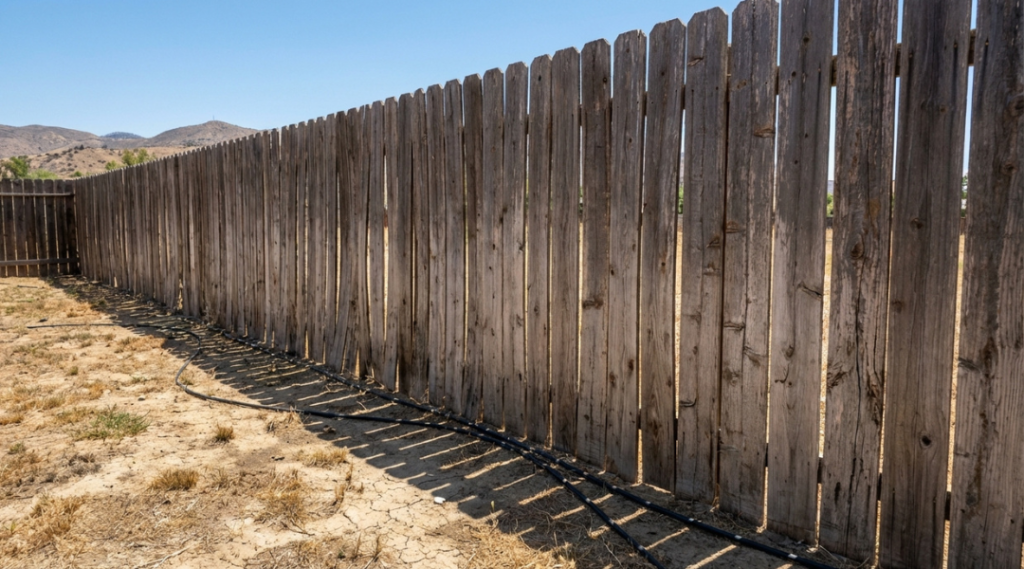
Wood shrinks as it dries, which loosens fasteners and creates gaps between boards. You’ll see this most obviously in fence panels installed during wetter winter months. By summer, those tight-fitted boards may have gaps of 1/4 inch or more.
This constant expansion and contraction cycle weakens joints and connections. Nails work loose, screws lose their grip, and boards warp away from rails. In coastal areas with morning fog, the daily wet-dry cycle accelerates this damage even further.
Vinyl doesn’t absorb moisture, so it maintains consistent dimensions year-round. This stability means gates stay aligned and panels don’t develop gaps.
Irrigation, Soil Moisture, And Post Stability
Southern California’s terrain varies from sandy coastal soils to clay-heavy inland areas. Where your fence sits on this spectrum affects post stability and rot potential.
Wood posts buried in soil face constant moisture from irrigation systems. Most Southern California yards run sprinklers 2-4 times per week during summer. This keeps the bottom of wood posts wet even when surface conditions are bone dry. Ground contact creates the perfect environment for rot and termite activity.
Posts in clay soils retain moisture longer than those in sandy terrain. Clay also expands and contracts with moisture changes, which loosens posts over time. Sandy soils drain quickly but offer less stability for posts.
Moisture-related wood post problems include:
- Rot starting at the soil line within 5-8 years
- Termite damage beginning at buried sections
- Posts leaning as soil shifts with irrigation cycles
Vinyl posts don’t rot regardless of soil moisture. However, you still need proper installation depth and concrete footings to handle soil movement common in Southern California terrain.
Lifecycle Cost Drivers: Wood Vs Vinyl
Wood and vinyl fencing diverge sharply in upfront spending and long-term expenses. Material price, installation labor, ongoing maintenance, repair cycles, and potential replacement within a decade all shape the true cost of each fencing material.
Upfront Material And Labor Differences
Vinyl fencing carries higher initial material costs than wood. Expect to pay $22–$38 per linear foot for vinyl materials compared to $15–$28 per linear foot for wood. A 100-foot vinyl privacy fencing run typically totals $2,200–$6,000, while the same length of wood fence cost runs $1,800–$5,500.
Labor adds another layer. Vinyl installation ranges from $8–$20 per linear foot, wood from $7–$16. Southern California’s higher labor rates push both figures toward the upper end of those ranges.
| Cost Component | Wood | Vinyl |
|---|---|---|
| Material (per linear ft) | $15–$28 | $22–$38 |
| Labor (per linear ft) | $7–$16 | $8–$20 |
| 100 ft total | $1,800–$5,500 | $2,200–$6,000 |
A basic vinyl fence starts at roughly 1.5 to 2 times the upfront cost of common wood options like pine or pressure-treated lumber. Cedar and redwood narrow that gap but still undercut vinyl fence cost in most scenarios.
Ongoing Maintenance Labor And Materials
Wood fencing demands regular upkeep to prevent rot, warping, and insect damage. You’ll need to apply staining or sealing every two to five years, depending on Southern California’s sun exposure and moisture levels. Each staining cycle costs $100–$500 in materials and labor for a typical residential fence.
Annual maintenance cost for wood averages $100–$500. That includes cleaning, resealing, and minor board repairs. Over ten years, you’re looking at $1,000–$5,000 in cumulative maintenance.
Vinyl fencing requires minimal attention. An occasional rinse with a garden hose and mild detergent keeps panels clean. No painting, staining, or sealing is necessary. Annual maintenance cost typically stays below $50, adding up to $500 or less over a decade.
Southern California’s dry climate and intense UV exposure can fade both materials, but vinyl resists moisture-related damage better than wood. Wood remains vulnerable to termites and dry rot even in arid regions.
Repair Frequency And Panel Replacement
Wood fence panels crack, warp, and splinter over time. Southern California’s temperature swings accelerate weathering. Expect to replace 10–20% of boards within the first ten years, costing $200–$800 depending on panel size and wood species.
Vinyl panels rarely need replacement unless subjected to impact damage. Vinyl privacy fencing can crack under extreme force, but normal wear causes little deterioration. Replacement panels run $50–$150 each, though you’ll seldom need them.
Repair frequency breakdown:
- Wood: Minor repairs every 1–2 years; board replacement every 3–5 years
- Vinyl: Rare repairs; occasional hose fitting or cap replacement
Wood’s vulnerability to insect damage adds unplanned repair costs. Termites and carpenter ants target untreated or poorly sealed wood, sometimes requiring fumigation and board replacement.
Probable Replacement Timelines Within Ten Years
A well-maintained wood fence lasts 15–20 years, but Southern California’s climate can shorten that lifespan. Within ten years, you might replace 20–30% of your wood fencing if maintenance lapses. Full replacement cost mirrors initial installation: $1,800–$5,500 for 100 linear feet.
Vinyl fencing typically lasts 20–30 years with minimal intervention. You won’t face full replacement cost within the first decade under normal conditions. The long-term costs favor vinyl because you avoid the second installation cycle that wood often requires.
Ten-year outlook:
- Wood: Possible partial replacement ($400–$1,500); definite ongoing staining
- Vinyl: No expected replacement; negligible maintenance
If you plan to stay in your home beyond ten years, vinyl’s durability eliminates the expense and hassle of a mid-life fence overhaul.
Field Observations From All Counties Fence & Supply Projects
Years of installations across Southern California reveal clear patterns in how wood and vinyl fences age, where they fail first, and how homeowners adjust their budgets after experiencing real-world costs.
Maintenance Patterns In Riverside Neighborhoods
In Riverside’s inland heat, wood fences show visible wear by year three. You’ll typically need to restain or reseal around this mark to prevent cracking and fading. Most homeowners spend $300–$600 every 2–3 years on these treatments for an average-sized yard.
Vinyl fences in the same neighborhoods require basic cleaning once or twice yearly. A garden hose and mild soap handle most dirt and dust buildup. The total annual cost stays under $50 if you do it yourself.
Wood maintenance schedule observed:
- Year 1–2: Minimal work
- Year 3–4: First restaining needed
- Year 5–7: Board replacement begins
- Year 8–10: More frequent repairs
Vinyl maintenance schedule observed:
- Year 1–10: Annual washing only
Temperature swings cause both materials to shift, but vinyl shows less structural damage. Wood posts near irrigation lines or sprinklers deteriorate faster, often requiring replacement before other sections.
Common Failure Points By Material
Wood fences fail most often at ground-level posts where moisture collects. Even pressure-treated pine shows rot within 5–7 years in areas with regular watering. Cedar and redwood last longer but still weaken at soil contact points.
Gate hinges on wood fences loosen as boards shrink and expand. You’ll need to tighten hardware yearly and may need to reposition hinges by year five. Horizontal rails also split where they attach to posts, especially on taller privacy fences.
Vinyl failures occur less frequently but center on poor installation. Posts that aren’t set deep enough lift during high winds. Panels can crack if hit by lawnmowers or heavy objects, requiring full section replacement rather than simple board swaps.
Most common repair needs by year 10:
| Material | Primary Issues | Estimated Repair Cost |
|---|---|---|
| Wood | Rotted posts, loose boards, failed stain | $800–$1,500 |
| Vinyl | Cracked panels, loose posts | $200–$500 |
Bracing becomes necessary for wood fences by year six in windy areas. Additional support posts or diagonal bracing prevent leaning and extend fence life.
Budget Adjustments After Year Five
Most homeowners underestimate wood fence upkeep costs in their initial planning. By year five, you’ve likely spent $1,000–$2,000 on staining, minor repairs, and hardware replacement. This number climbs as boards need individual replacement.
Vinyl owners typically spend under $300 total through year five. The main expense comes from occasional panel replacement if damage occurs, but many go the full decade without major repairs.
10-year cost comparison for 150 linear feet:
- Wood: $2,400 initial + $2,500 maintenance = $4,900 total
- Vinyl: $3,600 initial + $400 maintenance = $4,000 total
After experiencing first-hand maintenance demands, many homeowners increase their annual fence budget or plan for earlier replacement. Wood fence owners often allocate $400–$600 yearly starting in year six. Vinyl owners rarely adjust their budgets beyond the initial cleaning supplies.
Labor costs shift the math further if you hire professionals for wood maintenance. Professional staining and repairs add $500–$800 every 2–3 years versus doing it yourself.
Interpreting Tradeoffs Beyond Total Cost
Price comparisons tell only part of the story when choosing between wood and vinyl fencing. Your decision will affect how your property looks over time, how well the fence performs in Southern California’s climate, and what message it sends to future buyers.
Aesthetic Aging And Perceived Value
Wood fences deliver a natural warmth that many homeowners prefer for curb appeal. The material weathers to a silvery gray patina if left untreated, which some find attractive while others consider it worn-looking. You can maintain the original color with staining every few years.
Vinyl fences keep their color throughout their lifespan without fading significantly in most cases. However, the plastic appearance doesn’t appeal to everyone. Some buyers view vinyl as less authentic or premium compared to natural wood, especially in neighborhoods where traditional materials dominate.
Your property’s architectural style matters here. Craftsman and ranch-style homes often look better with wood fences that match their natural materials. Modern homes may pair well with vinyl’s clean lines. The perceived value isn’t just about the material cost but how well the fence fits your home’s character and your neighborhood’s aesthetic standards.
Privacy, Rigidity, And Structural Performance
Both materials work well as privacy fences when installed with minimal gaps between boards. Vinyl panels come in solid sheets that guarantee no sight lines. Wood boards can shrink slightly as they dry, creating small gaps over time.
Wind performance differs between the two options. Vinyl has some flex that helps it withstand gusts without cracking. Wood is more rigid but can split or break in extreme winds common in some Southern California areas. Vinyl posts may bend or lean if not properly reinforced.
Temperature swings affect both materials. Wood expands and contracts with humidity changes. Vinyl can become brittle in cold snaps and may warp slightly under intense sun exposure, though this is less common with quality products designed for hot climates.
Resale Signaling And Long-Term Property Planning
A well-maintained fence of either material adds to your resale value. Buyers typically view a newer vinyl fence as years of maintenance-free ownership ahead. A fresh wood fence signals traditional quality but also implies future upkeep costs.
Your timeline for selling matters. If you plan to sell within five years, a vinyl fence shows as a long-term investment that won’t need immediate attention. A wood fence at the same age may already show wear that concerns buyers unless you’ve kept up with treatments.
Real estate agents in Southern California often note that fence condition impacts buyer decisions more than fence material. A faded, cracked vinyl fence hurts your property value just as much as a rotting wood fence. The best choice depends on which material you’ll actually maintain according to its needs over your ownership period.