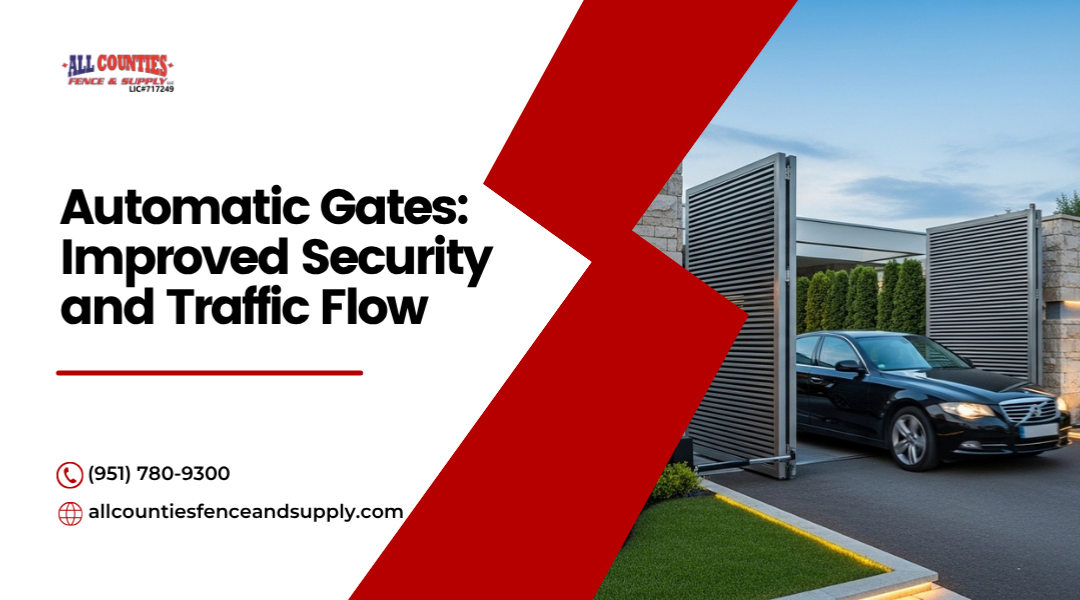
Managing security and traffic movement at your commercial property can be a daily challenge. Automatic gate systems solve both problems by keeping your entrances protected while maintaining steady vehicle flow. An automatic gate improves security by controlling who enters and exits your property while streamlining traffic to prevent congestion and confusion at key entry points.
When you automate your gates, you eliminate the need for manual operation, reducing human error and ensuring consistent performance throughout each day. The system secures the perimeter by default, allowing access only when permission is given, while keeping deliveries, staff, and visitors moving efficiently. As a result, you gain both safety and convenience without sacrificing operational speed.
Choosing the right setup for your layout and traffic patterns adds even more value. Commercial properties vary in size and usage, but with proper gate design, operator selection, and access control integration, you can create a dependable boundary that balances speed, security, and cost. Working with experienced professionals like All Counties Fence & Supply helps you apply technology that truly enhances how your facility operates.
Where Automated Gate Systems Provide Operational Value
Automated gate systems add measurable value by improving traffic flow, standardizing access, and reducing time‑consuming manual oversight. You gain consistent entry control, safer circulation, and smoother logistics across commercial areas that face heavy daily use.
High-Traffic Commercial Entry Points And Congestion Patterns
Busy commercial properties depend on fast and consistent movement of vehicles and people. An automatic gate at key entry points reduces congestion by regulating how cars, trucks, and deliveries pass through secure zones. With timed cycles and motion sensors, automated systems limit idle time while maintaining security.
Installing commercial automatic gates helps prevent traffic buildup during shift changes or peak hours. This controlled entry process supports predictable scheduling for employees and visitors. By using remote access controls or touchless systems, you can also maintain safety standards while keeping traffic moving smoothly.
A properly configured automatic entrance can even be programmed to adjust speed or access priority during certain hours. In high-volume logistics sites, this feature ensures that delivery vehicles and vendors enter without interrupting normal facility operations.
Multi-Tenant Properties Versus Single-Operator Facilities
Different property types benefit from automation in distinct ways. Multi-tenant complexes—such as office parks or mixed-use centers—often have multiple users who need varied levels of access. Automated gates simplify management by integrating with card or code systems, allowing each tenant secure and separate entry.
For single-operator facilities, like warehouses or distribution centers, gate automation reduces the need for constant staffing. You can schedule openings for deliveries, lock gates automatically after hours, and track access logs digitally.
In multi-tenant settings, flexibility matters most. Tenants share the same gate hardware but maintain individual permissions through automated access control. In single-operator environments, reliability and throughput take priority, supported by fewer touchpoints and faster entry cycles. Both setups demonstrate how automated security gates adjust to unique operational patterns.
When Manual Access Control Limits Scalability
Manual gates rely on staff or guards to open and close entry points, which slows response times as volume grows. When your facility expands, this approach becomes harder to sustain. Automated gates scale easily by integrating new users, vehicles, and security levels without increasing labor.
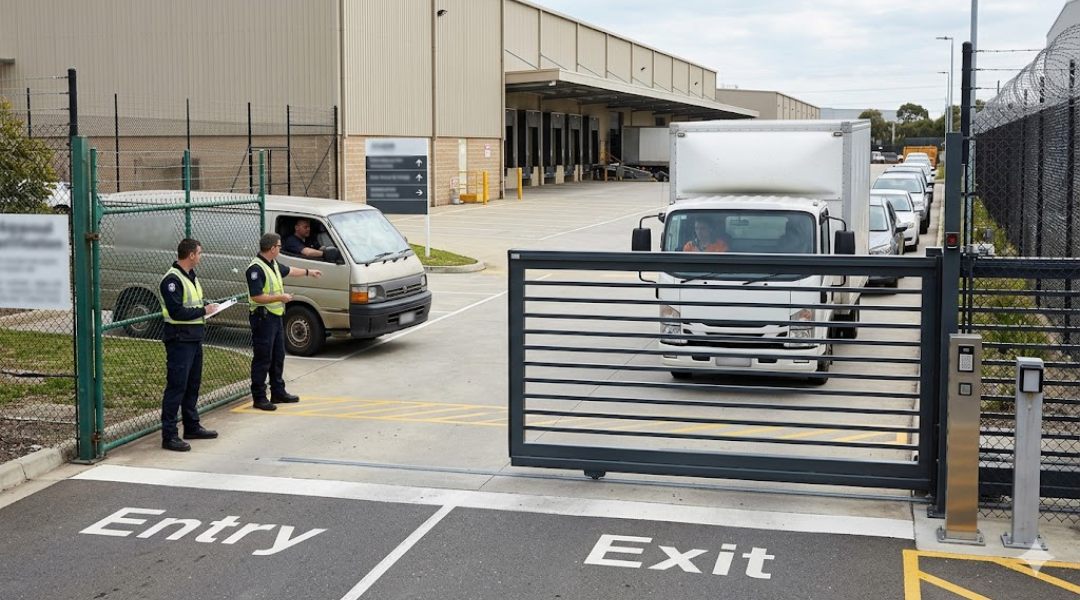
Unlike manual systems, automatic security gates maintain consistent timing and data tracking with less supervision. This reliability keeps operations efficient when your property handles larger fleets or extended working hours.
Through networked access panels and smart control software, automation supports growth without adding complexity. By replacing gate attendants with remote or sensor‑based systems, you improve long‑term scalability and reduce operational cost while keeping a strong security posture.
Gate Automation Systems And Control Mechanisms
Automatic gate systems rely on coordinated mechanical and electronic components to manage vehicle entry, increase safety, and maintain efficient traffic movement. You gain precise control through integrated access control systems, reliable gate operators, and responsive safety features that adapt to commercial site needs.
Sliding, Swing, And Barrier Arm Configurations
You can select from sliding gates, swing gates, or barrier arm gates depending on your space, security, and traffic conditions.
Sliding gates move horizontally along a track and suit sites with limited space behind the gate line. They use slide gate operators that engage a chain or rack-and-pinion system for smooth motion.
Swing gates open inward or outward using automatic gate openers that power one or two panels. They are common in properties with shorter driveways and lower to moderate vehicle volumes. For wide entrances like parking lots or checkpoints, barrier arm gates provide fast operation and clear traffic direction, opening in seconds to control vehicle access efficiently.
Comparison Table:
| Configuration | Ideal Use | Motion Type | Common Operator |
|---|---|---|---|
| Sliding Gate | Tight spaces, heavy use | Horizontal | Slide gate operator |
| Swing Gate | Moderate space, aesthetic focus | Hinged | Swing gate operator |
| Barrier Arm Gate | High traffic, quick access | Vertical lift | Barrier arm mechanism |
Access Technologies Including RFID, Keypad, And Remote Entry
Modern gate access control systems give you flexible ways to manage entry. RFID tags read vehicle credentials automatically, letting approved vehicles pass without stopping. They are suitable for staff parking areas or delivery zones where frequent access is needed.
Keypad entry allows users to enter a numeric code using a weather-resistant keypad. It provides reliable access without issuing physical keys or cards. Remote entry options, such as mobile apps or key fobs, use encrypted signals to activate gate openers securely from a distance.
You can combine these technologies into a layered access control system that tracks use, logs time stamps, and integrates with cameras or alarms. This enhances both convenience and accountability across your property’s entry points.
Sensor Systems, Safety Loops, And Fail-Safe Operations
To ensure safe and consistent function, sensor systems and safety loops detect approaching vehicles and prevent accidental closures. Ground loops sense metal objects and hold the gate open until the area is clear. Infrared or ultrasonic sensors add another detection layer, reducing the risk of collisions with vehicles or pedestrians.
Systems also include emergency release mechanisms that let you manually open gates during power failures. Many gate operators feature built-in fail-safe or fail-secure modes. A fail-safe system unlocks when power is lost to allow emergency access, while fail-secure systems stay locked for added security.
By using these features, you maintain smooth gate movement, reliable protection, and safe operation even under demanding or unexpected conditions.
Security Layers Created Through Controlled Access Points
Automatic gate systems create several layers of protection by regulating who enters, when entry occurs, and how those movements are tracked. They use connected technologies such as credential verification, surveillance integration, and event logging to maintain strong perimeter security and dependable traffic control.
Credential-Based Entry And Unauthorized Access Reduction
Controlled access begins with credential-based entry. You can set up gates to accept only verified credentials, such as key cards, PIN codes, RFID tags, mobile access, or license plate recognition. This ensures that only authorized individuals can pass through, reducing the chance of tailgating or unauthorized entry.
Unlike standalone gate operators, gate access control systems link every entry point to a central management platform. Administrators can quickly add or revoke permissions for staff, visitors, or contractors. Cloud-based systems allow you to make changes remotely and in real time.
To strengthen security, combine multiple methods of validation. For example:
| Credential Type | Verification Strength | Best Use Case |
|---|---|---|
| Key card | Moderate | Employee vehicle gateways |
| Mobile app | High | Multi-tenant facilities |
| License plate recognition | High | Parking structures and service entrances |
Using unique identifiers for each user creates accountability and filters out anyone attempting to exploit shared codes or badges.
Integration With Surveillance And Perimeter Fencing Systems
Pairing automatic gates with cameras, intercom systems, and fencing adds depth to your property’s security strategy. When a vehicle approaches, integrated video feeds let your security team verify credentials visually before releasing access.
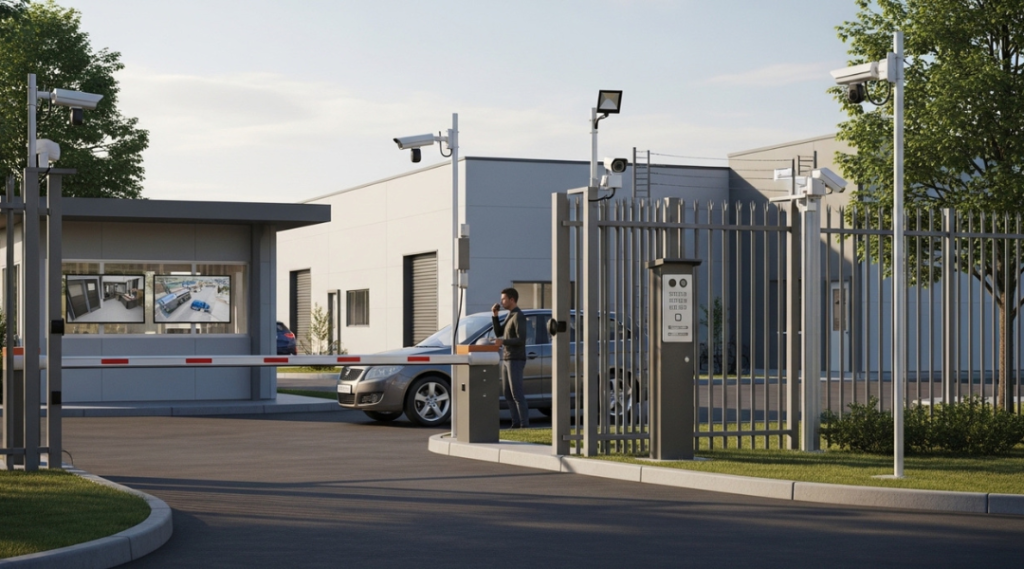
Intercom systems enable voice or video communication between entry points and the control desk. This helps verify visitor identity and document the interaction. You can also connect surveillance cameras to analytics software that detects unusual motion or attempts to tamper with a gate reader.
Linking these tools to a perimeter fencing network prevents unauthorized detours around entry points. The combination of physical barriers, electronic locking mechanisms, and monitored video ensures every movement across the perimeter is intentional and authorized.
Event Logging And Audit Trail Implications
Modern gate systems record each access attempt in detailed access logs, whether successful or denied. These digital records help you trace security incidents, monitor usage patterns, and confirm compliance with safety policies.
Cloud-based monitoring platforms can sort, filter, and export data for audits or investigations. They display information such as credential type, time of access, gate location, and camera footage tied to each event.
Maintaining audit trails reduces guesswork after a breach or discrepancy. You can quickly compare real-time data with historical trends to locate weak points or patterns of misuse. Properly configured logging also supports coordination between facility managers and external security partners, ensuring comprehensive oversight of your controlled-access environment.
Interpreting Tradeoffs Between Speed, Security, And Cost
Choosing how your automatic gate system operates requires balancing speed, security, and cost efficiency. You must consider how quickly vehicles move through entry points, how thoroughly access is verified, and what level of investment provides lasting reliability and manageable upkeep. Making informed decisions about these tradeoffs helps maintain safety while keeping operations efficient and expenses practical.
Faster Throughput Versus Controlled Verification Delays
Faster gate operation raises vehicle throughput, which reduces traffic congestion and improves daily operations on busy commercial properties. However, higher speed can reduce the time available to confirm identities or detect unauthorized access. You must decide whether rapid entry or meticulous verification better fits your site’s risk profile.
Automatic gates that include smart sensors and license plate recognition can perform both functions effectively. They allow traffic to move quickly while still logging each entry event for later review. For high-security environments, setting short verification delays can prevent tailgating and unauthorized entry without creating long wait times.
Use of adaptive speed settings can further fine-tune performance. For example, gates may open faster during peak hours but revert to a slower, more secure mode during off-hours. This approach improves operational efficiency while maintaining consistent control over access.
System Complexity Versus Long-Term Reliability
Adding advanced features such as biometric readers or cloud-based control increases system capability but also introduces more parts that need upkeep. Complex systems enhance security and data integration, yet they depend heavily on reliable networks and regular software updates. You must plan for these needs to avoid unexpected downtime.
Simpler gate systems, while offering fewer advanced options, often provide greater mechanical reliability and lower maintenance costs. Scheduling preventive maintenance—checking motors, sensors, and safety circuits—helps extend equipment life regardless of system type.
When deciding between advanced technology and simplicity, look at long-term reliability and the skill level of your maintenance team. A well-maintained mid-range system can outperform a high-end setup that lacks consistent oversight.
Initial Investment Versus Reduced Staffing Requirements
Automatic gates require a noticeable upfront investment in hardware, installation, and integration with access systems. Yet, this cost often offsets over time through reduced staffing needs and improved operational efficiency. Automated access reduces reliance on guards for manual monitoring during every vehicle entry.
To visualize cost balance:
| Category | Short-Term Impact | Long-Term Impact |
|---|---|---|
| Capital Cost | High purchase and setup expense | Paid off over system lifespan |
| Labor Cost | Lower immediate offset | Ongoing savings from reduced staffing |
| Maintenance | Moderate, scheduled care needed | Predictable, prevents costly repairs |
You can justify higher initial costs by tracking savings from automation, faster traffic processing, and fewer entry management errors. Over several years, these systems typically deliver measurable returns through reduced labor, improved tenant satisfaction, and smoother traffic flow.
All Counties Fence & Supply Perspective On Gate Integration
Installing an automatic gate system requires careful coordination between your existing fence, perimeter design, and property operations. Success depends on proper planning, accurate site assessment, and the right automation tools that maintain both convenience and consistent security performance.
Aligning Gate Systems With Existing Perimeter Infrastructure
You need to start with a thorough site assessment before integrating a new gate system. This step helps identify connection points, material compatibility, and potential power or control line limitations. Evaluating your current fence type—metal, wood, masonry, or composite—ensures that the gate frame and operating mechanism mount securely and operate smoothly.
All Counties Fence & Supply adapts gate installations to match your perimeter’s structure and layout. Their approach emphasizes load distribution, correct hinge positioning, and sensor placement to prevent mechanical stress or uneven wear. Electrical pathways and conduit routing receive equal attention to protect against exposure or interference.
Beyond physical alignment, you also integrate access control systems such as keypads, badge scanners, or remote devices. Matching these systems to your existing security network allows you to maintain consistent protection without reconfiguring multiple controls.
Adapting Automation To Varied Commercial Property Layouts
Every commercial site presents different movement patterns and access points. Office complexes, warehouses, and distribution centers need tailored automation based on lane width, entry frequency, and delivery schedules. You determine gate type—sliding, swing, bi-fold, or vertical pivot—by measuring clearances and traffic space availability.
All Counties Fence & Supply evaluates these factors through on-site observation and layout review. The company prioritizes configuration accuracy to ensure that opening speeds and safety sensors match daily traffic volumes. For high-use entrances, durable motors and sensor-linked safety systems reduce downtime and improve operational consistency.
Automation settings often vary by zone. For instance, backlot loading areas may need time-delay closures, while front entries use quick-response openers for smoother access. Adjusting these programs minimizes waiting times while maintaining secure access control across multiple gates.
Balancing Traffic Flow Efficiency With Security Consistency
Efficient traffic management requires synchronized technology between gate motion, surveillance, and entry authorization. Automatic gates should maintain steady vehicle flow without compromising your property’s defense perimeter. Coordinating gate timing with traffic sensors and intercom communication helps prevent congestion near entry points.
All Counties Fence & Supply uses data from site assessments to determine gate cycle rates and sensor integration. They often tie gates to camera monitoring or license plate recognition systems, which improves verification speed while reducing the need for manual checks.
To maintain consistency, your automation must balance vehicle clearance speed with response readiness. Slow cycles frustrate visitors, but gates that open too quickly may risk unauthorized access. Setting programmable logic controls keeps both safety and mobility stable across changing traffic conditions.